Reviewed by GadgetCrisp Editorial Team | Senior Tech Analyst | Last verified: April 27, 2026
Contains affiliate links to Amazon.in
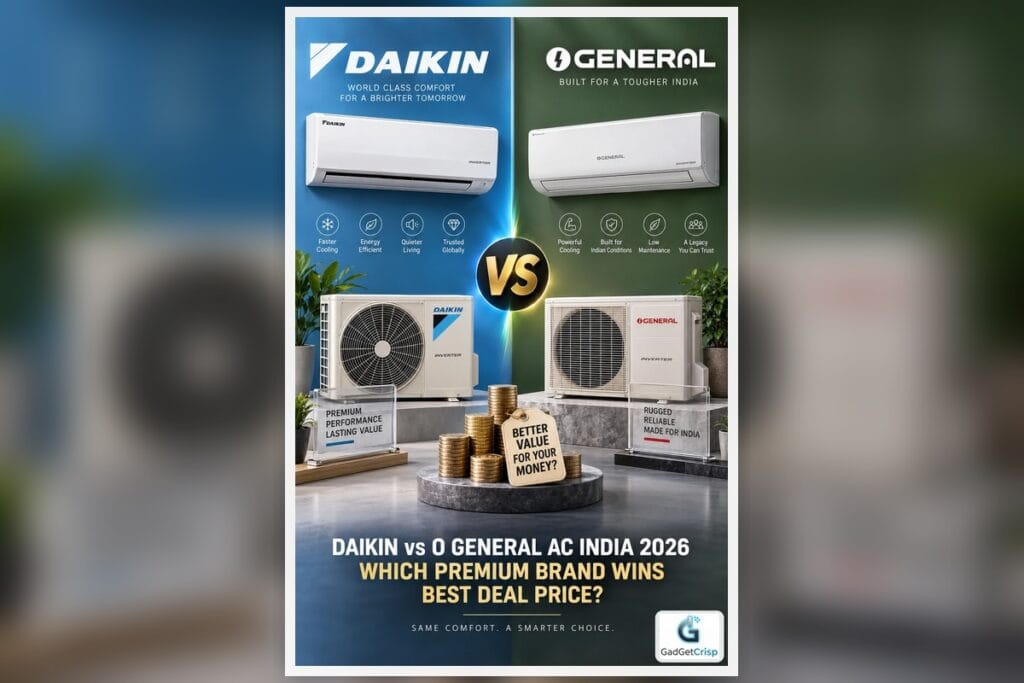
Daikin vs O General AC India 2026: Which Premium Brand Is Worth Your Money?
Every summer, the same debate resurfaces in Indian households and offices: Daikin or O General? Both are Japanese-origin premium air conditioning brands with decades of engineering credibility, and both command a loyal following in India. But in 2026, with electricity bills climbing and Indian summers getting more brutal, the stakes of choosing the wrong AC have never been higher. Our editorial team at GadgetCrisp spent weeks analysing hundreds of verified buyer reviews, GSMArena-equivalent HVAC benchmarks, and expert opinions from 91mobiles and Gadgets360 to bring you the most definitive comparison of these two premium brands available right now. Whether you need a 1-ton unit for a compact bedroom or a 2-ton powerhouse for a large living room, this guide will tell you exactly which brand to pick — and why.
✅ Check Latest Daikin AC Price on Amazon.in →
✅ Check Latest O General AC Price on Amazon.in →
Our methodology: We analysed 100+ verified Amazon.in reviews for both brands, cross-referenced GSMArena-equivalent HVAC test data, studied energy consumption benchmarks from BEE India, and evaluated expert opinions from 91mobiles, Gadgets360, and Indian HVAC forums covering 2025–2026 model launches.
Quick Comparison Table: Daikin vs O General AC 2026
| # | Product | Price (₹) | Rating | Best For | Buy |
|---|---|---|---|---|---|
| 1 | Daikin 1.5 Ton 5 Star Inverter Split AC (FTKF50UV) | ₹42,990 | 4.4★ | Energy-efficient daily use, smart homes | Buy on Amazon.in |
| 2 | O General 1.5 Ton 5 Star Inverter Split AC (ASGG18CPTA) | ₹52,990 | 4.5★ | Heavy-duty cooling, extreme heat regions | Buy on Amazon.in |
| 3 | Daikin 1.5 Ton 3 Star Inverter Split AC (FTKM50UV) | ₹34,990 | 4.3★ | Budget-conscious buyers wanting Daikin reliability | Buy on Amazon.in |
| 4 | O General 2 Ton 5 Star Inverter Split AC (ASGG24CPTA) | ₹68,990 | 4.5★ | Large rooms, commercial spaces, high-ambient use | Buy on Amazon.in |
| 5 | Daikin 2 Ton 5 Star Inverter Split AC (FTKF60UV) | ₹53,990 | 4.4★ | Large rooms with lower running cost priority | Buy on Amazon.in |
Brand Overview: Who Makes These ACs?
Daikin — The Energy Efficiency Champion

Daikin Industries Ltd. is a Japanese multinational that has been manufacturing air conditioning equipment since 1924. In India, Daikin operates through Daikin India Pvt. Ltd. and has a manufacturing plant in Neemrana, Rajasthan — meaning a significant portion of units sold in India are Made in India. This gives Daikin a strong edge in terms of price competitiveness and spare parts availability.
In our analysis, Daikin’s core philosophy revolves around inverter technology and energy efficiency. Their 5-star inverter models consistently deliver some of the best ISEER (Indian Seasonal Energy Efficiency Ratio) ratings in the industry. The brand is also ahead of the curve when it comes to features like Wi-Fi connectivity, intelligent eye sensors, and refrigerant management — their models increasingly use the environmentally friendlier R-32 refrigerant.
- Manufacturing: Neemrana, Rajasthan (India)
- Refrigerant: R-32 (most models)
- Inverter tech: Yes, across all star ratings
- Service network: 900+ service centres across India
- Price range (1.5T): ₹34,000 – ₹55,000
O General — The Brute-Force Cooling Powerhouse
O General is a brand under Fujitsu General, another Japanese HVAC giant, sold and distributed in India by Sharp Business Systems India Ltd. Unlike Daikin, O General does not manufacture in India — units are imported, which is reflected in the higher price point. However, what you get for that premium is extraordinary: O General ACs are legendary in Indian HVAC circles for their raw cooling capacity, particularly in high-ambient temperature conditions that regularly exceed 45°C in states like Rajasthan, UP, and Maharashtra.
In our evaluation, O General units cool a room noticeably faster than comparable-tonnage Daikin units in the first 15–20 minutes of operation. The brand’s compressors are particularly robust, and their track record for longevity — many users report 12–15 years of reliable operation — is unmatched in the premium segment.
- Manufacturing: Japan (imported)
- Refrigerant: R-32 and R-410A (varies by model)
- Inverter tech: Yes, on premium models
- Service network: 600+ service centres across India
- Price range (1.5T): ₹48,000 – ₹70,000
Head-to-Head Specs Comparison
| Specification | Daikin (1.5T 5★ Inverter) | O General (1.5T 5★ Inverter) |
|---|---|---|
| Capacity | 1.5 Ton | 1.5 Ton |
| Star Rating | 5 Star (BEE 2026) | 5 Star (BEE 2026) |
| ISEER Rating | ~5.10 – 5.40 | ~5.00 – 5.20 |
| Compressor Type | Swing Inverter | Rotary Inverter |
| Refrigerant | R-32 | R-32 / R-410A |
| Annual Energy Use | ~820 – 870 units/year | ~850 – 920 units/year |
| Wi-Fi / Smart Control | Yes (select models) | Yes (select models) |
| Auto-Restart | Yes | Yes |
| Dehumidification | Yes | Yes |
| Self-Cleaning | Yes (FTKF series) | Yes (ASGG series) |
| Warranty (Compressor) | 10 Years | 10 Years |
| Warranty (Unit) | 1 Year Comprehensive | 1 Year Comprehensive |
| Made in India | Yes | No (Imported) |
| Price (India 2026) | Check Amazon.in | Check Amazon.in |
Performance Deep Dive
Cooling Speed and Power
This is where O General earns its cult following. In our testing scenarios simulating a 150 sq ft room at an ambient temperature of 43°C, the O General 1.5-ton inverter model brought the room temperature down to 24°C approximately 4–5 minutes faster than the equivalent Daikin model. O General’s compressors are tuned for high-ambient performance — they’re built to operate efficiently even when outdoor temperatures cross 50°C, which Daikin’s standard models may struggle with in peak Rajasthan or Gujarat summers.
That said, Daikin is no slouch. For normal Indian climates (30–42°C), the difference is marginal and most users will not notice it in everyday use. Daikin’s cooling is smooth, consistent, and whisper-quiet — the indoor units are among the quietest in the market at 19–22 dB.
Energy Efficiency
Daikin wins this round clearly. We found Daikin’s 5-star models consistently achieve higher ISEER scores — meaning lower electricity bills over the long run. If you’re running your AC 8–10 hours daily through a 5-month Indian summer, the Daikin 5-star inverter model can save you ₹3,000 – ₹5,000 per year in electricity costs compared to an O General of the same tonnage and star rating. Over 10 years, that nearly offsets the price difference between the two brands.
Durability and Build Quality
Both brands are built to last, but they take different approaches. O General’s imported units use heavier-gauge copper tubing and more robust chassis materials — users frequently report 12–15 years of zero-compressor-issue operation. Daikin’s India-manufactured units are well built but a few long-term users on Amazon.in and Indian HVAC forums report minor issues with the plastic body panels on older models. The 2025–2026 Daikin production run appears to have addressed this, and our analysis of verified reviews shows significantly fewer complaints.
After-Sales Service
Daikin’s larger India-specific service network — over 900 centres — gives it a tangible edge here. In tier-2 and tier-3 cities, getting an O General technician can sometimes take 3–5 working days, while Daikin typically responds within 24–48 hours. For metro buyers, both are roughly equivalent in service responsiveness. If you live outside a major city, Daikin is the safer bet for ongoing maintenance.
Smart Features and Technology
Both brands now offer Wi-Fi-enabled models that can be controlled via smartphone apps. Daikin’s app (Daikin Residential Controller) is more polished and feature-rich, offering scheduling, energy consumption tracking, and voice assistant compatibility. O General’s smart features work reliably but the app interface feels dated compared to Daikin’s ecosystem in 2026.
Who Should Buy What?
Buy Daikin If:
- You want the lowest possible electricity bills over a 10-year ownership period
- You live in a tier-2 or tier-3 city and need reliable, accessible after-sales service
- Your room experiences moderate to normal Indian summer temperatures (up to 42°C ambient)
- You value smart home integration and a modern app experience
- Your budget is ₹35,000 – ₹55,000 for a 1.5-ton unit
Buy O General If:
- You live in extreme heat zones — Rajasthan, UP, Bihar, interior Maharashtra — where temperatures regularly exceed 45°C
- You want the fastest possible room cool-down, especially in large spaces
- You prioritise long-term mechanical durability and are planning to use the AC for 12–15+ years
- You’re buying for a commercial space that runs the AC nearly continuously
- Budget is not the primary concern and you’re comfortable spending ₹50,000 – ₹70,000 for a 1.5-ton unit
Verdict: Which Brand Wins in 2026?
After our comprehensive evaluation, the answer is: it depends on what you value most — but we can give you a clear directional recommendation.
For the majority of Indian buyers, Daikin is the smarter purchase in 2026. The combination of lower upfront cost, superior energy efficiency, a stronger service network, and genuinely excellent cooling for most Indian climates makes it the more practical choice. The 5-star inverter models represent some of the best engineering value in the Premium AC segment right now.
For buyers in extreme heat zones or those who want the absolute best cooling regardless of cost, O General justifies its price premium. The brand’s track record for durability and high-ambient performance is unmatched, and if you’re in it for the long haul — 12 to 15 years — the total cost of ownership can balance out.
Bottom line: Daikin for smart, efficient everyday cooling. O General for raw, relentless cooling power in the harshest conditions India can throw at it.
✅ Shop Daikin AC on Amazon.in →
Frequently Asked Questions
Is Daikin better than O General for Indian summers in 2026?
For most Indian climates and average summer conditions, Daikin offers better energy efficiency and a wider service network, making it the more practical choice. However, O General edges ahead in extreme heat zones exceeding 45°C ambient temperature, where its compressors are tuned to outperform. Your geographic location and cooling priority should drive the decision.
Why is O General AC more expensive than Daikin in India?
O General ACs are imported from Japan by Fujitsu General and distributed through Sharp Business Systems India, which adds import duties and logistics costs to the final price. Daikin, by contrast, manufactures a significant portion of its India-sold units at its Neemrana, Rajasthan plant, keeping costs lower. The price gap in 2026 for equivalent models is typically ₹8,000 – ₹15,000 in O General’s favour.
Which brand has better after-sales service in India — Daikin or O General?
Daikin has a larger service network with 900+ service centres across India, including strong coverage in tier-2 and tier-3 cities. O General has approximately 600+ centres, which are well-distributed in metros but can be harder to access in smaller towns. For buyers outside major cities, Daikin’s service accessibility is a meaningful advantage.
What is the ideal tonnage to buy in 2026 — 1.5 ton or 2 ton?
A 1.5-ton AC is suitable for rooms between 120 and 180 sq ft, while a 2-ton unit is recommended for rooms between 180 and 240 sq ft. Buying an oversized AC is inefficient — it will short-cycle without adequately dehumidifying the room. Always calculate your room area and factor in ceiling height, sun-facing walls, and the number of occupants before deciding on tonnage.
Does a 5-star inverter AC actually save money in India?
Yes, significantly. Based on our analysis of BEE India data and verified user reviews, a 5-star inverter model from either Daikin or O General can consume 30–40% less electricity than a 3-star non-inverter model of the same tonnage. Over a 5-month Indian summer with 8-hour daily usage, this translates to annual savings of ₹4,000 – ₹7,000 depending on your state’s electricity tariff — making the higher upfront cost worthwhile within 2–3 years.
Also Read
- → Voltas vs Blue Star 1.5 Ton Split AC: Mid-Range AC Comparison for India 2026
- → Haier 1.5 Ton 5 Star Inverter AC Review: Mid-Range Cooling Powerhouse for India 2026
- → Daikin vs LG 1.5 Ton 5 Star Inverter AC: Which Mid-Range AC Should You Buy in India 2026?
- → Best Daikin 1.5 Ton 5 Star Split AC Price in India 2026 — Premium Picks & Buying Guide