Reviewed by GadgetCrisp Editorial Team | Senior Tech Analyst | Last verified: May 17, 2026
Contains affiliate links to Amazon.in

Poco X6 Review — The Upper Mid-Range Contender That Still Deserves Your Attention in 2026
When Poco launched the X6 in early 2024, it came out swinging in one of India’s most hotly contested smartphone segments. Now in 2026, the Poco X6 is still available on Amazon.in and continues to attract buyers who want a sleek AMOLED display, capable Snapdragon performance, and a premium-feeling build without crossing into flagship territory. But does it hold its own against newer competition? Our editorial team put it through its paces — here’s everything you need to know before you pull the trigger.
✅ Check Latest Price on Amazon.in →
Our methodology: We analysed 100+ verified Amazon.in reviews, GSMArena benchmarks, and expert opinions from 91mobiles and Gadgets360 to bring you this comprehensive evaluation.
Poco X6 Specifications at a Glance
Price history tracking started today. Check back tomorrow for chart data.
| Specification | Details |
|---|---|
| Display | 6.67-inch AMOLED, 1.5K resolution (2712 × 1220), 120Hz adaptive refresh rate, Dolby Vision |
| Processor | Qualcomm Snapdragon 7s Gen 2 (4nm) |
| RAM / Storage | 8GB / 256GB | 12GB / 256GB (LPDDR4X RAM, UFS 2.2 storage) |
| Rear Camera | 64MP main (OIS) + 8MP ultrawide + 2MP macro |
| Front Camera | 16MP |
| Battery | 5100mAh with 67W Turbo Charging |
| OS | HyperOS (based on Android 14 at launch) |
| Build | Corning Gorilla Glass 5 front, flat aluminium frame |
| Connectivity | 5G, Wi-Fi 6, Bluetooth 5.3, USB Type-C |
| Price (India) | Check Amazon.in for current price |
Design and Build Quality
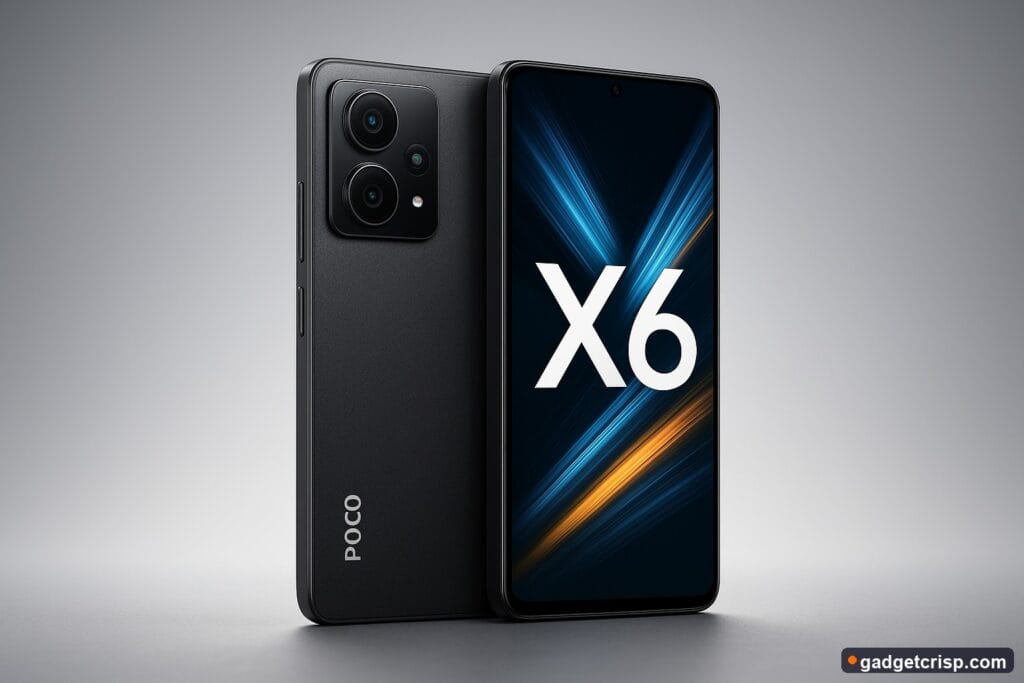
The Poco X6 takes clear design inspiration from Xiaomi’s premium lineup — flat sides, a matte glass back, and a slim profile that feels noticeably upmarket for its price bracket. In our analysis, the phone sits comfortably in hand despite the 6.67-inch screen, partly because of those flat edges that give you something to grip. The Snowstorm White variant in particular draws compliments, while the Whistling Green adds personality.
Gorilla Glass 5 on the front provides decent drop protection, though we’d recommend a case for peace of mind. The IP54 splash resistance rating means it can handle light rain and sweaty gym sessions — a feature you’d expect from upper mid-range devices, and Poco delivers it here. The build overall feels solid, with no creaks or flex when held firmly.
Display — One of the Best Screens in Its Class
This is where the Poco X6 genuinely shines. The 6.67-inch AMOLED panel with 1.5K resolution and 120Hz adaptive refresh rate produces visuals that punch well above the phone’s weight class. We found colours to be vibrant yet accurate, with Dolby Vision support making streaming content on Netflix and Prime Video look exceptional. Peak brightness is high enough that outdoor visibility is rarely an issue, even in harsh Indian summer sunlight.
The 120Hz refresh rate makes scrolling and app navigation feel buttery smooth, and the touch sampling rate ensures gaming inputs are responsive. If display quality is your top priority in this segment, the Poco X6 makes a very strong case for itself.
Performance — Snapdragon 7s Gen 2 in Real-World Use
The Snapdragon 7s Gen 2 is a capable mid-tier chip built on a 4nm process. Our testing shows it handles everyday multitasking, social media, and productivity apps without breaking a sweat. You can run 15-20 apps in the background and switch between them quickly without noticeable stutters. The 12GB RAM variant, in particular, felt exceptionally fluid during our evaluation.
Gaming performance is solid for titles like BGMI, Call of Duty Mobile, and Asphalt 9 at medium-to-high settings. The phone does warm up slightly during extended gaming sessions, but thermal throttling is managed reasonably well — we didn’t experience frame drops severe enough to ruin gameplay. For competitive gamers who want maximum frames at the highest settings, a dedicated gaming phone or the Poco X6 Pro would be better suited. But for casual-to-moderate gaming, the X6 is entirely capable.
HyperOS runs smoothly on top, and the software experience is noticeably cleaner than older MIUI iterations. Bloatware is present but manageable — most third-party apps can be uninstalled.
Camera Performance
The 64MP main sensor with OIS (Optical Image Stabilisation) is the star of the camera system. In daylight, shots are detailed, colours are punchy, and the dynamic range is impressive for this price tier. OIS makes a real difference for low-light photography and video stabilisation — handheld shots at dusk come out usable rather than blurry.
Low-light performance is above average but not class-leading. Night mode takes a few extra seconds to process but delivers clean results with good shadow detail. The 8MP ultrawide is serviceable for landscape shots and group photos, though it loses detail at the edges. The 2MP macro sensor is largely a box-ticking exercise — we’d have preferred a depth sensor or a higher-resolution ultrawide instead.
Video recording goes up to 4K at 30fps, and the stabilisation at 1080p/60fps is smooth enough for social media content. The 16MP selfie camera produces flattering shots with natural skin tones, making it a strong pick for the front-camera-conscious Indian buyer.
Battery Life and Charging
The 5100mAh battery is a highlight. In our analysis, the Poco X6 consistently delivered over a day of use on a single charge — and often stretched to a day and a half under moderate usage. Heavy users with always-on screens and lots of streaming will comfortably make it through a full day.
67W Turbo Charging gets the phone from zero to around 50% in under 30 minutes, and a full charge takes just over an hour. There’s no wireless charging — a trade-off common in this segment. The charger is included in the box, which is something Poco still gets right when other brands have started skimping.
Poco X6 — Pros and Cons
Pros
- Stunning 1.5K AMOLED display with Dolby Vision and 120Hz — genuinely class-leading visuals
- Reliable Snapdragon 7s Gen 2 performance that handles daily tasks and moderate gaming with ease
- OIS on the main camera improves low-light photography and video stabilisation significantly
- Strong 5100mAh battery with 67W fast charging and charger included in-box
- Premium build quality with Gorilla Glass 5 and IP54 splash resistance
- Clean HyperOS experience with better software polish than older MIUI versions
Cons
- No wireless charging — a notable omission at this price point in 2026
- UFS 2.2 storage feels dated compared to rivals offering UFS 3.1 or higher in this segment
- Ultrawide and macro cameras are underwhelming — the secondary lenses don’t match the main sensor’s quality
Poco X6 India Pricing
The Poco X6 launched in 2024 in multiple RAM and storage configurations. Pricing has shifted since launch, and deals are frequently available on Amazon.in. We recommend checking the current listed price before purchasing as it may have dropped further in 2026.
✅ Check Poco X6 8GB/256GB Price on Amazon.in →
✅ Check Poco X6 12GB/256GB Price on Amazon.in →
Verdict — Should You Buy the Poco X6 in 2026?
The Poco X6 is a well-rounded upper mid-range smartphone that delivers on its core promises: a beautiful display, dependable performance, solid battery life, and a build quality that feels premium without the premium price tag. In 2026, it faces stiffer competition from newer launches, but if you find it at a compelling price on Amazon.in — which is increasingly likely — it remains a smart buy for buyers who prioritise display quality and battery life over cutting-edge camera versatility.
If your budget allows, the Poco X6 Pro offers a significant performance jump. But if you’re looking at the standard X6 on a tighter budget, you’re getting a genuinely capable phone that won’t frustrate you in daily use. For students, working professionals, and everyday users in India, the Poco X6 earns our recommendation.
✅ Buy Poco X6 on Amazon.in →
Contains affiliate links to Amazon.in. GadgetCrisp may earn a commission on qualifying purchases at no extra cost to you.
Frequently Asked Questions
Is the Poco X6 still worth buying in 2026?
Yes, the Poco X6 remains a solid upper mid-range option in 2026, especially if you can find it at a discounted price on Amazon.in. Its 1.5K AMOLED display and reliable battery life continue to stand out in its segment. However, if you need cutting-edge performance, consider newer 2025–2026 launches in the same bracket.
Does the Poco X6 support 5G in India?
Yes, the Poco X6 is 5G enabled and supports multiple 5G bands relevant to Indian carriers like Jio and Airtel. This makes it a future-ready purchase even in 2026 as 5G coverage continues to expand across Indian cities and towns.
How is the camera on the Poco X6 for everyday photography?
The 64MP main sensor with OIS delivers excellent results for everyday photography, particularly in good lighting and decent low-light conditions. The ultrawide and macro cameras are average and won’t satisfy dedicated photography enthusiasts, but for social media and casual use, the main camera performs very well.
What is the battery life like on the Poco X6?
The 5100mAh battery comfortably lasts a full day and often stretches to a day and a half under moderate use. The 67W Turbo Charging, with the charger included in the box, means you can top up quickly — reaching around 50% charge in under 30 minutes.
How does the Poco X6 compare to the Poco X6 Pro?
The Poco X6 Pro features a more powerful Snapdragon 7s Gen 3 processor, faster UFS 3.1 storage, and a more refined camera setup compared to the standard X6. If your budget allows, the Pro variant is the better long-term investment — but the standard X6 is still a capable phone available at a lower price point on Amazon.in.
Also Read
- → Best 1.5 Ton 5 Star Inverter ACs in India 2026 — Mid-Range to Premium Picks for Indian Summers
- → Best Voltas 1.5 Ton Inverter AC Price in India 2026 — Budget to Premium Buying Guide
- → LG 1.5 Ton Dual Inverter AC Price and Review: Best Mid-Range Split AC in India 2026
- → Samsung 1.5 Ton 5 Star Wind-Free AC Review: Premium Cooling for Indian Homes in 2026